
When Control Over Food Starts Controlling You | with Kate Purcell
At her tenth hospital admission, fourteen year old Kate Purcell pulled her own feeding tube out on the side of the road and called her parents to come get her. At the time, she was certain it was her decision. She's since come to see it differently: that wasn't Kate. That was the eating disorder, fighting to stay in control.
Almost three decades on, and more than a decade into a career supporting other people's mental health, Kate is living through a version of that same fight again, an atypical anorexia diagnosis in her forties that she never saw coming.
NOW STREAMING ON ALL MAJOR PLATFORMS
This episode includes open discussion of eating disorders, body image, psychosis, and hospitalisation. If anything in this conversation feels heavy for you, the National Alliance for Eating Disorders helpline (1866 662 1235) and Lifeline (13 11 14) are available for support.
Our full crisis services and support directory has more.
In this episode, you'll hear:
👉 "There was literally no Kate left. Anorexia had taken over."— Kate describes losing her entire sense of identity to the illness by her mid-teens, to the point where she believed the eating disorder's cruelty and selfishness were simply who she was.
👉 A childhood comparison to her twin brother shaped her sense of self-worth long before the eating disorder began— Kate traces a direct line from feeling "worthless" next to her outgoing twin to the moment, after a rejection in year 8, that she decided weight was the one thing she could control.
👉 She spent a full year psychotic and undiagnosed, believing her spirit had died and she was in hell, and told no one— Her family assumed she was simply depressed. She says it was harder than anything her eating disorder ever put her through.
👉 At 41, she was diagnosed with atypical anorexia, a diagnosis she didn't see coming— She's open that this current chapter is still being written, and that she doesn't claim to be fully "healed."
THE CONVERSATION
Two books, two very different jobs
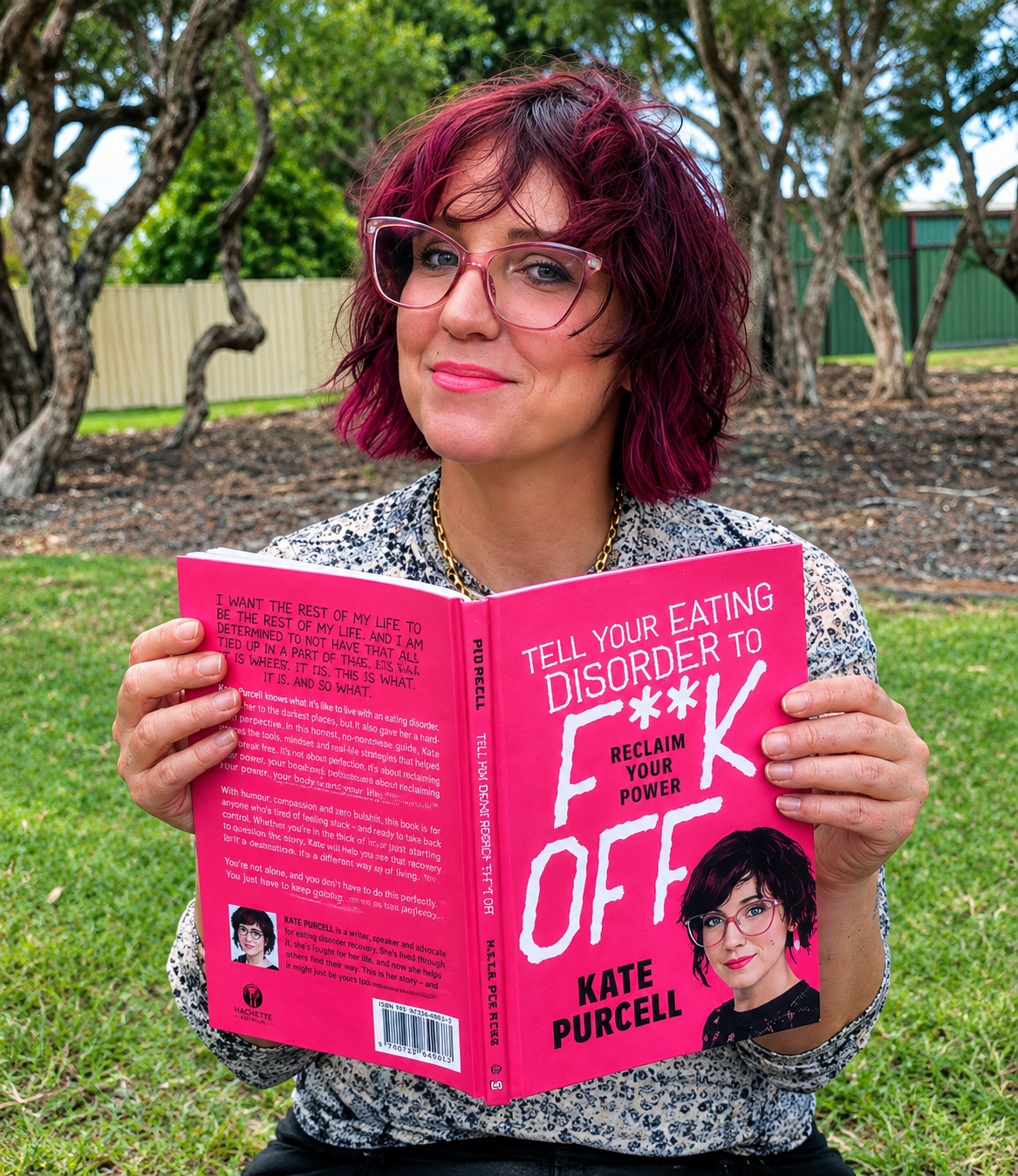
Kate's first book, Hope, Ink, is a memoir spanning her whole life: childhood, teenage anorexia, a period of recreational drug use in her early twenties, the psychosis and eventual schizoaffective disorder diagnosis that followed, and the recovery after. Her second book, Tell Your Eating Disorder To F*ck Off, is a self-help workbook, built to be written in, aimed specifically at people currently in the grip of an eating disorder. She's candid that she wrote it while still actively working through her own relapse, describing herself as being "on the journey with the reader" rather than writing from the far side of full recovery.
What atypical anorexia actually is
Kate explains that atypical anorexia carries the same psychological features as anorexia nervosa (the obsession with weight loss and fear of weight gain) but without the person necessarily reaching a critically low body weight. The distinction, she says, is largely about immediate medical risk rather than the internal experience, which she describes as identical. Her own diagnosis, in her early 40s, came as a genuine shock, arriving well after she assumed that chapter of her life was behind her.
Losing herself to the illness at 14
Kate traces her own dieting back to primary school, intensifying after a rejection from a boy she liked in year 8. By 14 she was hospitalised, moving in and out of Princess Margaret Hospital across roughly two years, often with a nasogastric tube, before an extended stay at Hollywood Clinic where she says she finally started to recover. She's frank that during the worst of it, she didn't know who she was outside the illness. She assumed the eating disorder's selfishness and cruelty were her own personality, rather than symptoms layered on top of a person who still had passions, dreams, and a future underneath.
What people get wrong about eating disorders
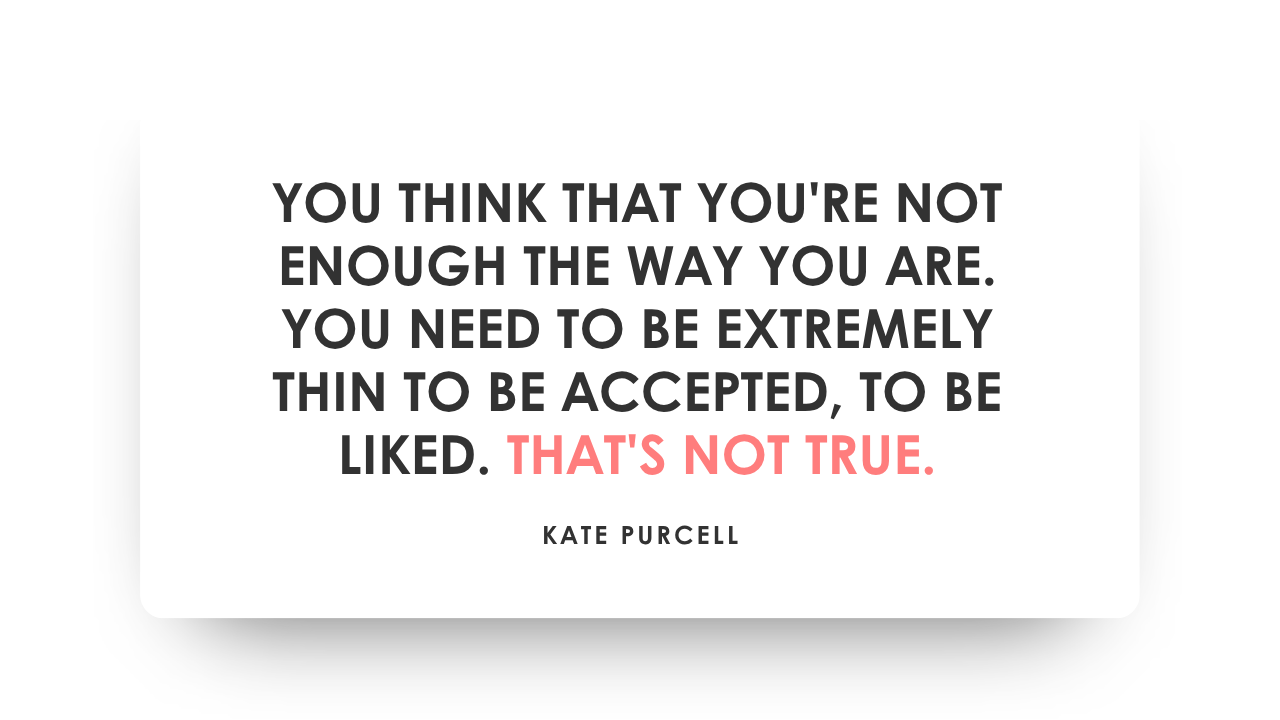
Asked what's most misunderstood, Kate is immediate: it isn't about food. Food, she says, is something you eventually have to rebuild a relationship with, but the illness itself is about self-worth, control, and a belief that you aren't acceptable as you are. She also flags less obvious behaviours worth recognising, like isolating on hard body image days, avoiding social situations built around food, and quietly compensating after eating, patterns she says can run so automatically they're easy to miss even in yourself.
What actually helps her now
Kate says the daily work now is less about willpower and more about repetition: reminding herself that thinness isn't something she actually wants, only something the illness wants, and refusing to let it, in her words, "dull her sparkle." She's built a private practice as a peer worker and recovery coach, working with people navigating eating disorders and psychotic illness alike, drawing directly on both sides of her own lived experience.
-
Atypical anorexia describes someone who meets the psychological and behavioural criteria for anorexia nervosa, including an intense fear of weight gain and disturbed body image, but who is not at a critically low body weight for their height and build. It's recognised as no less serious than anorexia nervosa, since the psychological impact and health risks can be just as significant even without a low BMI.
-
Schizoaffective disorder involves psychotic symptoms, such as delusions or hallucinations, occurring alongside a mood disorder, such a depressive or manic episode. Schizophrenia, by contrast, does not require a co-occurring mood disorder. The psychotic features can look similar across both conditions, but the presence of sustained mood symptoms is what leads to a schizoaffective diagnosis.
-
Substance-induced psychosis can occur during or shortly after drug use, but some research also points to drug use, particularly of stimulants, as a potential contributing factor in the later emergence of psychotic disorders in people who may already be vulnerable to them. The relationship is complex and varies significantly between individuals.
-
A manic episode typically involves elevated mood, high energy, impulsivity, and reduced need for sleep. A mixed episode involves symptoms of mania and depression occurring together or in rapid succession, such as high energy alongside irritability, anger, or significant low mood, and is generally considered more distressing to experience.
-
Peer support work is delivered by people with their own lived experience of mental illness or recovery, working alongside (rather than instead of) clinical professionals. It's built on the idea that someone who has navigated similar challenges can offer a particular kind of understanding and practical support that complements traditional therapy or psychiatric care.
About Kate Purcell
Kate Purcell is a Perth based author, speaker, and peer support worker who has spent over a decade working in mental health services. She lives with lived and living experience of anorexia, atypical anorexia, and schizoaffective disorder, and is the author of Hope, Ink and Tell Your Eating Disorder To F*ck Off. She currently works in private practice as a peer worker and recovery coach, supporting people navigating eating disorders and psychotic illness.
👉 Want to find her books or get in touch? Visit katepcell.com →
Resources mentioned in this episode
Hope, Ink and Tell Your Eating Disorder To F*ck Off, available on Amazon and in select Perth bookstores
National Alliance for Eating Disorders helpline: 1866 662 1235
